Where an additive field correction stops
Trust requires matching evidence and action granularity to the structure of model failure. This page separates three questions: what information reaches the model, what residual structure remains, and what an additive field-constant correction can change.
Spatial reliability gap
additive field action versus sub-field residual structure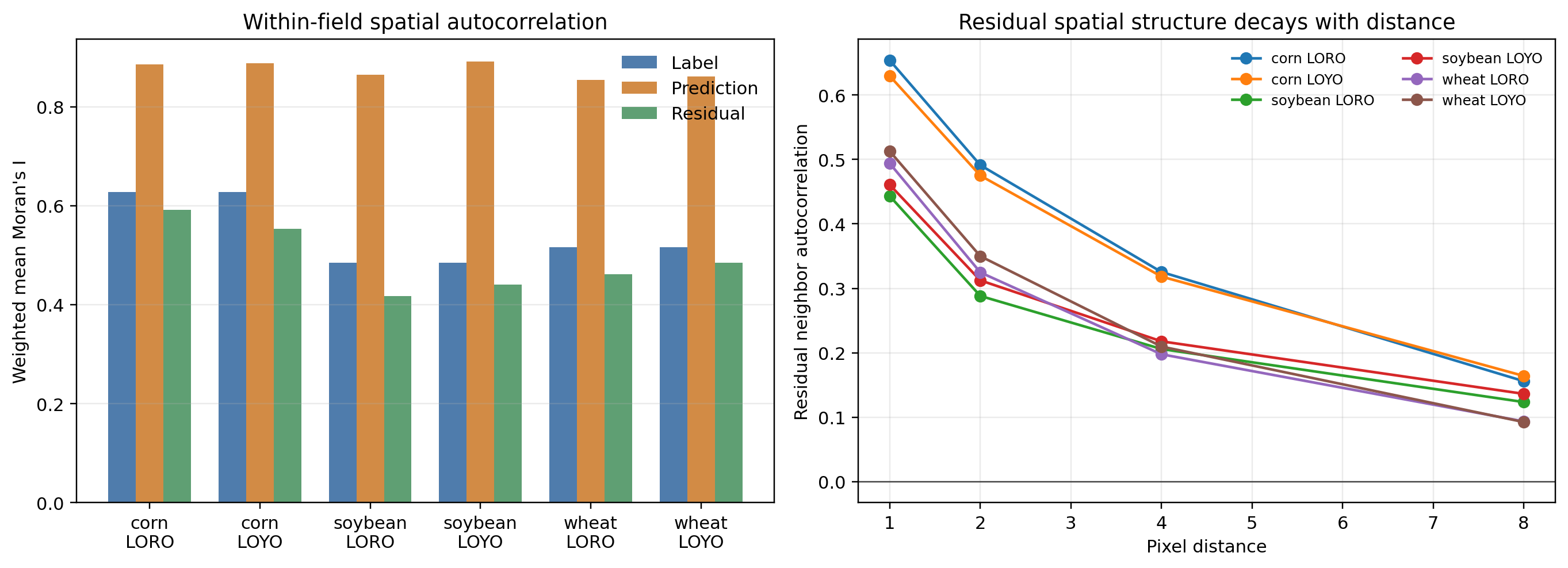
Information and action granularity across the pipeline
context only, not a causal diagnosis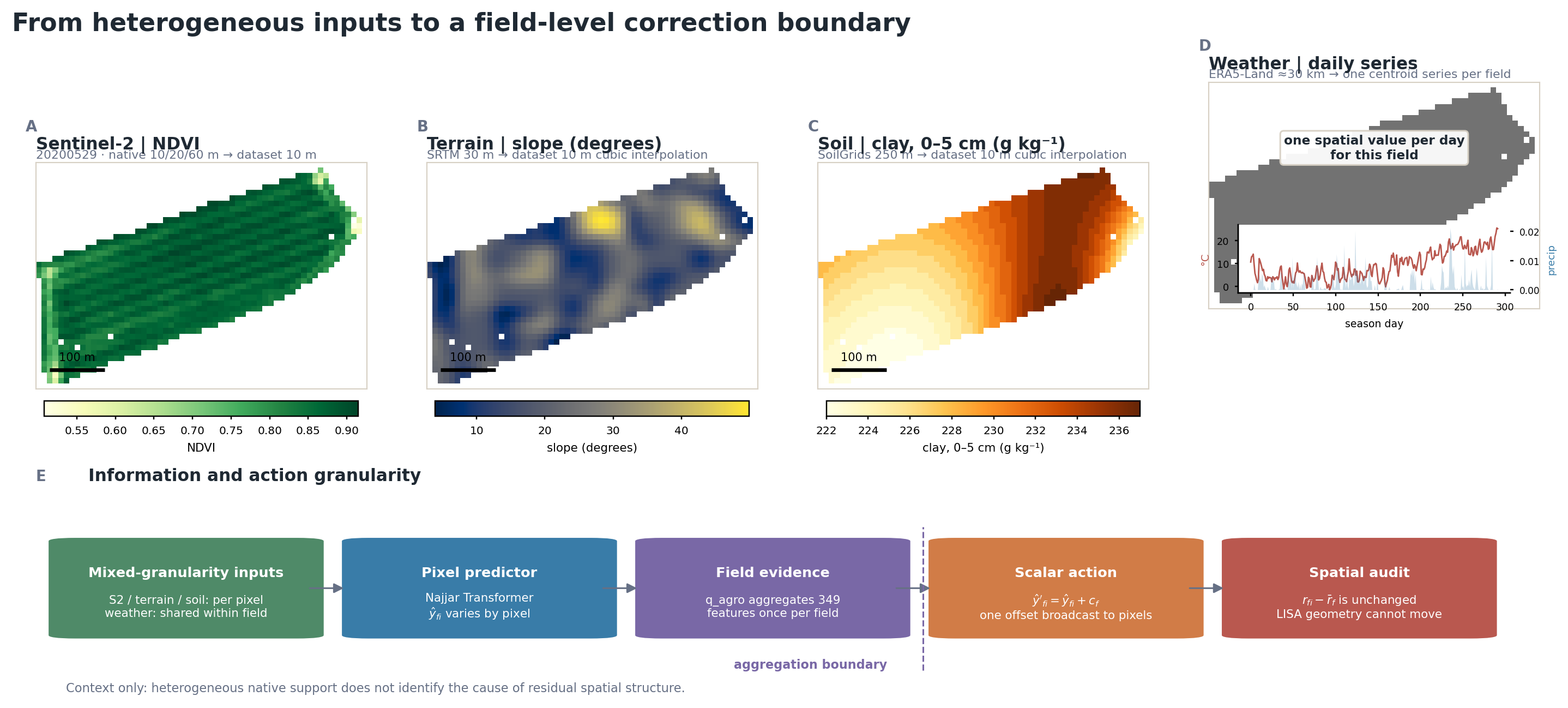
Interpretation boundary. Native support is shown to describe the data pipeline. It does not establish that modality resolution caused the residual clusters or that finer inputs would necessarily remove them.
An additive field-constant action cannot move local clusters
current F1.4 showcase · wheat LORO · SR 0.2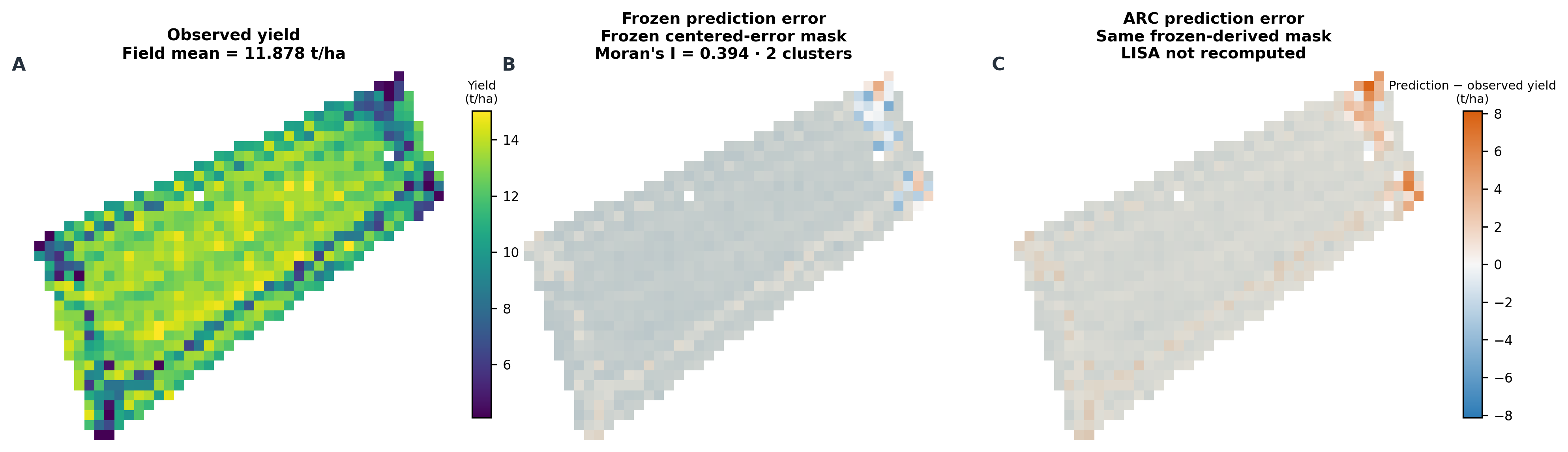
Method details
Error follows the field explorer convention, prediction − GT. The frozen-derived mask uses 8-neighbour queen weights, 999 permutations, Benjamini–Hochberg FDR q≤0.05, and a retained-pixel share of about 4.5%. The same mask is applied to the ARC error panel; LISA is deliberately not recomputed after correction. This is an explanation-alignment boundary and a negative result, not an agronomic or measurement diagnosis.
The continuous additive oracle quantifies the action-class floor
six crop × protocol settings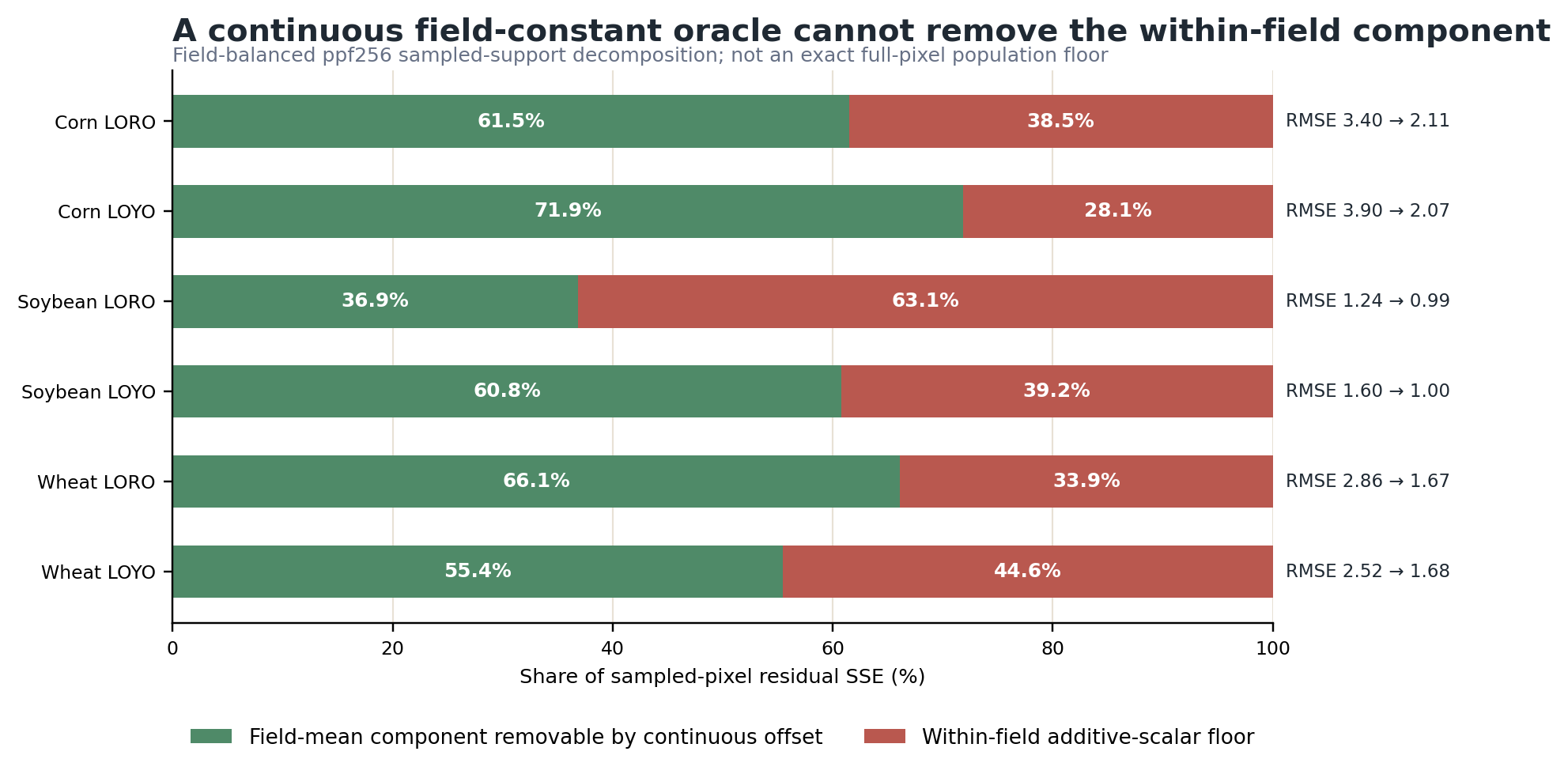
Share of field-balanced sampled-pixel residual SSE left after the optimal continuous field offset.
Exact for the available sampled OOF support, not an exact full-pixel population floor.
The result does not cover spatially varying, multiplicative, affine, or management-zone actions.
Two oracles answer different questions. This continuous oracle isolates the within-field floor for any real-valued additive offset. The separate five-action oracle measures perfect routing headroom within the implemented policy menu.
Counter-intuitive evidence signals
helpful versus harmful evidence-card cases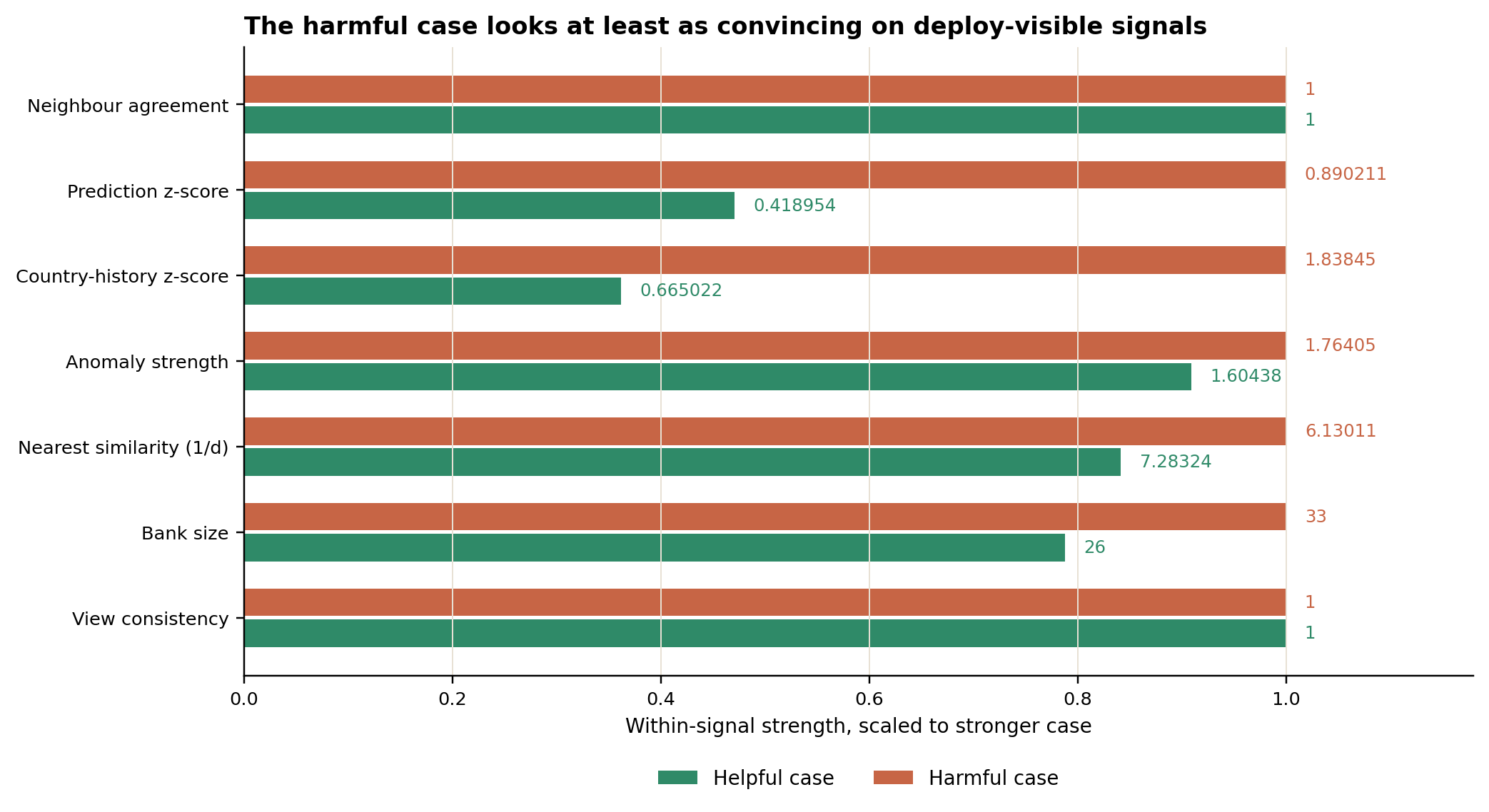
The harmful case looks more convincing on the obvious signals. Neighbour agreement and view consistency are both perfect in both cases, while the harmful case has a stronger prediction z-score, stronger anomaly score, closer nearest neighbour, and larger bank. Evidence disclosure is therefore valuable because it shows why forced action selection is unreliable.
